Food Is Becoming More Calorific but Less Nutritious Due to Rising Carbon Dioxide
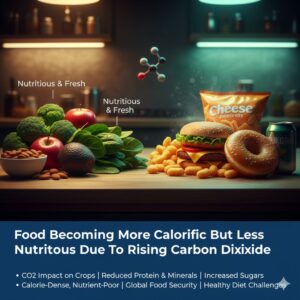
As the world grapples with climate change, much of the public discussion focuses on extreme weather, rising sea levels, and global temperatures. Less visible—but potentially just as dangerous—is a quieter transformation happening in the food we eat. Scientific research increasingly shows that rising levels of carbon dioxide (CO₂) in the atmosphere are altering the nutritional quality of staple crops, making many foods higher in calories but lower in essential nutrients.
This shift has serious implications for global health, particularly for populations already vulnerable to malnutrition. While food production may increase in quantity under higher CO₂ conditions, the quality of that food is declining, raising urgent questions about how climate change will shape human nutrition in the decades ahead.
The Carbon Dioxide Effect on Plants
Carbon dioxide is a key ingredient in photosynthesis, the process plants use to convert sunlight into energy. When CO₂ levels rise, many plants—especially major crops like wheat, rice, and corn—grow faster and produce more carbohydrates.
At first glance, this might sound like good news. Higher crop yields could help feed a growing global population. But the problem lies in what those crops are made of.
Under elevated CO₂ conditions, plants tend to accumulate more sugars and starches, increasing their calorie content. At the same time, they absorb fewer minerals from the soil and produce lower concentrations of protein and micronutrients such as iron, zinc, and magnesium.
In simple terms, crops grow bigger, but they become nutritionally diluted.
Calories Up, Nutrients Down
Numerous studies have demonstrated this effect across a range of staple foods. Researchers have found that when crops are grown in environments with higher CO₂ levels—similar to those expected later this century—they often show:
- Reduced protein content
- Lower levels of iron and zinc
- Decreased concentrations of calcium and magnesium
- Higher carbohydrate-to-nutrient ratios
This means people may consume the same amount of food—or even more calories—but receive fewer essential nutrients needed for healthy development and immune function.
For populations that rely heavily on plant-based staples for their nutrition, this shift could have devastating consequences.
Why Protein and Micronutrients Matter
Protein and micronutrients play a critical role in human health. Protein is essential for muscle growth, immune defense, hormone production, and tissue repair. Iron supports oxygen transport in the blood, zinc is vital for immune function and wound healing, and magnesium contributes to nerve and muscle health.
When diets lack these nutrients, the effects can include:
- Impaired immune systems
- Increased risk of infection
- Delayed growth and development
- Fatigue and reduced cognitive performance
These effects are particularly severe for children, pregnant women, and the elderly.
If staple foods like rice, wheat, and maize lose nutritional value, millions of people could face hidden hunger—a condition where calorie intake is sufficient, but nutrient intake is not.
A Global Health Concern
The nutritional decline of crops due to rising CO₂ is not evenly distributed across the world. Low- and middle-income countries are likely to be hit hardest, especially those where diets rely heavily on a small number of staple crops.
In many regions of Africa, South Asia, and Southeast Asia, people obtain the majority of their calories and nutrients from cereals and legumes. When these foods become less nutritious, there are few affordable alternatives.
Researchers estimate that declining nutrient levels in crops could place hundreds of millions of people at increased risk of deficiencies in iron and zinc alone—nutrients already lacking in many diets today.
Obesity and Undernutrition: A Dangerous Combination
One of the most troubling aspects of this trend is that it may worsen both obesity and malnutrition at the same time.
As foods become more calorific but less nutritious:
- People may eat more to feel satisfied
- Diets may become higher in refined carbohydrates
- Nutrient deficiencies may persist despite adequate calorie intake
This creates a paradox where individuals are overweight but undernourished—a condition increasingly observed worldwide.
Public health experts warn that rising CO₂ could intensify this pattern, making it harder to address obesity, diabetes, and micronutrient deficiencies simultaneously.
Why CO₂ Has This Effect
The mechanism behind this phenomenon is relatively straightforward. Elevated CO₂ stimulates plants to photosynthesize more efficiently, leading to increased carbohydrate production. However, the uptake of minerals from the soil does not increase at the same rate.
As a result, nutrients become “diluted” within the plant’s tissues. This is sometimes referred to as the carbon nutrient penalty.
Additionally, higher CO₂ levels can alter plant metabolism in ways that reduce nitrogen content, which directly affects protein levels in crops.
Climate Change Beyond Temperature
This issue highlights an important point: climate change is not just about warming temperatures. Atmospheric composition itself plays a critical role in shaping ecosystems and food systems.
Even if rising CO₂ helps some crops grow faster, the nutritional trade-off may undermine long-term food security and public health.
It also complicates efforts to measure agricultural success purely in terms of yield. Producing more food does not automatically mean producing better food.
Implications for Food Policy and Agriculture
Governments and international organizations face difficult choices as they respond to this emerging challenge. Traditional agricultural goals have focused on maximizing production, but nutritional quality must now become a central concern.
Potential policy responses include:
- Investing in crop varieties that retain nutrients under higher CO₂
- Encouraging dietary diversity to reduce reliance on single staples
- Supporting soil health to improve mineral availability
- Expanding food fortification programs
Without intervention, rising CO₂ could undermine decades of progress in reducing malnutrition.
Can Biofortification Help?
One promising approach is biofortification—the process of breeding crops to contain higher levels of essential nutrients.
Biofortified varieties of rice, wheat, beans, and maize already exist and have shown success in improving iron and zinc intake in some populations. However, researchers caution that rising CO₂ may still offset some of these gains unless breeding programs explicitly account for future atmospheric conditions.
This means agricultural research must not only look backward at current conditions but forward to the climate realities of the coming decades.
The Role of Diet Diversity
While staple crops remain essential, experts emphasize that diversified diets are one of the strongest defenses against nutrient loss.
Fruits, vegetables, legumes, nuts, and animal-source foods can help compensate for declining nutrient density in cereals. However, access to diverse foods depends heavily on income, infrastructure, and education.
In many parts of the world, such dietary shifts are not easily achievable without systemic change.
A Challenge for Global Nutrition Goals
The impact of rising CO₂ on food nutrition threatens global efforts to meet health and development targets, including goals related to hunger, child development, and disease prevention.
Nutrition experts warn that if current trends continue, climate change could reverse gains made in reducing micronutrient deficiencies over the past several decades.
This risk underscores the need to integrate climate science, agriculture, and nutrition policy more closely than ever before.
What Can Be Done?
Addressing the nutritional effects of rising carbon dioxide requires action on multiple fronts:
- Reducing greenhouse gas emissions to limit CO₂ concentration growth
- Reforming agricultural research priorities to focus on nutrient retention
- Strengthening public health nutrition programs
- Raising awareness about hidden hunger and dietary quality
While individual choices matter, the scale of the problem means systemic solutions are essential.
Conclusion: A Subtle but Serious Threat
The idea that food could become less nutritious while appearing more abundant is a troubling paradox of climate change. Rising carbon dioxide is quietly reshaping the foundations of human nutrition, increasing calorie content while stripping away essential nutrients.
This shift may not be immediately visible on supermarket shelves, but its long-term effects could be profound—particularly for the world’s most vulnerable populations.
As policymakers, scientists, and societies confront the challenges of climate change, the nutritional quality of food must be part of the conversation. Feeding the future is not just about producing enough calories—it is about ensuring that what we eat continues to sustain human health in a changing world.