Jeju Air Crash: South Korea Sets Up Independent Inquiry Into Disaster That Killed 179 Amid Delays and Acrimony
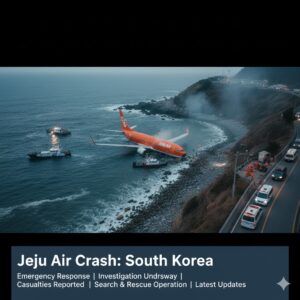
South Korea has announced the establishment of an independent parliamentary inquiry into the Jeju Air crash that killed 179 people, following months of mounting public anger, deepening mistrust in the official investigation, and persistent demands from victims’ families for transparency and accountability. The decision marks a significant escalation in the government’s response to what has become the deadliest aviation disaster in the country’s history and reflects broader concerns about how major national tragedies are investigated.
The inquiry comes after prolonged delays, disputes over preliminary findings, and accusations that the original investigation lacked independence. For many families who lost loved ones, the move is long overdue and represents a critical step toward uncovering the full truth behind the disaster.
The Crash That Shocked the Nation
The Jeju Air crash occurred on December 29, 2024, when a Boeing 737-800 operating an international flight attempted to land at Muan International Airport in South Jeolla Province. During the approach, the aircraft experienced a serious emergency that forced the pilots to attempt a belly landing. The plane overran the runway, collided with a concrete structure at the airport’s perimeter, and burst into flames.
Of the 181 people on board, only two survived. The loss of 179 lives sent shockwaves across South Korea and prompted an immediate national mourning period. Memorials sprang up across the country, while families of the victims demanded swift answers about what went wrong.
In the days following the crash, authorities suggested that a bird strike during the landing approach may have damaged the aircraft’s engines, contributing to the loss of control. While this explanation offered an initial framework for understanding the disaster, it also sparked intense debate and skepticism, particularly as details remained limited.
Growing Doubts Over the Official Investigation
The official investigation was led by the Aviation and Railway Accident Investigation Board, which operates under the Ministry of Land, Infrastructure and Transport. From the outset, families of the victims raised concerns about the board’s independence, arguing that a body under direct government control could not impartially investigate potential failures involving state agencies, airport infrastructure, or regulatory oversight.
Tensions escalated as months passed without a comprehensive public report. Interim findings reportedly suggested that pilot decisions played a significant role in the crash, including the shutdown of one engine that may still have been partially functional. Families and pilot unions strongly rejected this narrative, saying it unfairly shifted blame onto the flight crew while downplaying structural and systemic issues.
The controversy intensified when authorities postponed the release of an interim report after families protested its contents. For many relatives, the delay reinforced suspicions that the investigation was being managed to protect institutions rather than uncover uncomfortable truths.
A Climate of Acrimony and Protest
By mid-2025, the crash investigation had become a focal point of public anger. Families of the victims organized protests, held press conferences, and petitioned lawmakers to intervene. They accused authorities of withholding information, failing to communicate transparently, and excluding families from meaningful participation in the investigative process.
Legal representatives for the families argued that key questions remained unanswered. These included whether airport design contributed to the severity of the crash, why certain safety measures were not in place, and whether emergency response protocols were adequate. The presence of a solid concrete embankment at the end of the runway, in particular, became a symbol of potential regulatory failure.
Opposition politicians seized on the issue, framing it as another example of institutional opacity and weak accountability. Comparisons were drawn to previous national disasters, where delayed or flawed investigations had eroded public trust in government.
Parliament Steps In
Under increasing pressure, South Korea’s National Assembly voted to establish an independent parliamentary inquiry into the crash and the handling of the original investigation. The inquiry will be conducted by a special committee composed of lawmakers from both ruling and opposition parties, alongside external experts.
Unlike the original investigation, the parliamentary inquiry is designed to operate independently of government ministries. It will have the authority to summon witnesses, demand documents, and examine whether there were attempts to suppress, distort, or prematurely frame findings.
The committee’s mandate extends beyond identifying the technical causes of the crash. It will also examine whether government agencies responded appropriately in the aftermath, whether investigative procedures met international standards, and whether institutional conflicts of interest undermined public confidence.
Key Areas Under Review
The independent inquiry is expected to focus on several contentious issues that have dominated public debate since the crash.
One major area of scrutiny is the role of bird strikes and how airports manage wildlife hazards. While bird strikes are a known aviation risk worldwide, critics argue that proper mitigation measures, monitoring systems, and pilot guidance could significantly reduce their impact.
Another focal point is aircraft handling during emergencies. While pilot decision-making is an essential part of any crash investigation, families insist it must be evaluated in context, alongside training standards, airline policies, and the availability of accurate real-time information.
Infrastructure is also likely to feature prominently. The runway layout, safety zones, and the presence of rigid structures at the airport have raised questions about whether survivability could have been improved. Experts note that modern airport design increasingly emphasizes energy-absorbing materials to reduce fatalities during overruns.
The Human Cost
Behind the political debates and technical discussions lies the profound human tragedy of the crash. Victims included families returning from holidays, business travelers, and airline crew members. For many relatives, the pain of loss has been compounded by what they see as an unresponsive and defensive system.
Family members have described feeling excluded from the investigative process and treated as obstacles rather than stakeholders. Some have said they learned about key developments through media reports rather than official briefings. This sense of marginalization has fueled anger and mistrust, making reconciliation more difficult.
Psychological experts note that transparent investigations play a crucial role in helping families process grief. When answers are delayed or perceived as incomplete, trauma can deepen, prolonging emotional suffering and social conflict.
Government Response and Political Implications
Government officials have publicly welcomed the parliamentary inquiry, pledging cooperation and emphasizing their commitment to uncovering the truth. At the same time, some within the administration have cautioned against politicizing the tragedy or drawing conclusions before investigations are complete.
The inquiry’s launch carries significant political implications. It places renewed scrutiny on regulatory agencies and could lead to calls for structural reform, particularly regarding how accident investigations are organized. Lawmakers from multiple parties have suggested that South Korea may need a fully independent aviation investigation body, separate from ministries responsible for transport policy and infrastructure.
Failure to act on the inquiry’s findings could further damage public trust, not only in aviation safety but in government oversight more broadly.
A Broader Conversation About Safety and Accountability
The Jeju Air crash has reignited a national conversation about safety culture in South Korea. While the country boasts a strong record of technological development and infrastructure investment, critics argue that regulatory enforcement and transparency have not always kept pace.
Past disasters have shown that public trust depends not only on preventing accidents but also on how authorities respond when tragedies occur. Independent oversight, open communication, and accountability are increasingly seen as essential components of effective governance.
The parliamentary inquiry is therefore about more than one crash. It is a test of whether institutions can learn from failure and respond in a way that restores confidence rather than deepens division.
What Happens Next
The inquiry committee is expected to operate for several weeks, with the possibility of extensions if needed. Public hearings, closed-door testimony, and expert analyses will form the backbone of its work. A final report will be submitted to the National Assembly, along with recommendations for legal, regulatory, and institutional reforms.
For the families of the victims, the inquiry represents a chance—perhaps the last—to obtain clear, credible answers. For the government, it is an opportunity to demonstrate accountability and commitment to reform.
Conclusion
The Jeju Air crash remains one of the darkest moments in South Korea’s aviation history. Nearly a year after the disaster, grief has given way to anger, and sorrow has turned into a demand for truth. The establishment of an independent parliamentary inquiry reflects the depth of public dissatisfaction with how the tragedy has been handled.
Whether the inquiry succeeds will depend on its willingness to confront difficult questions and challenge entrenched interests. Its findings could reshape aviation safety oversight in South Korea and set new standards for transparency in the wake of national disasters.
For a country still mourning 179 lost lives, the stakes could not be higher.